You’re making one of the best career decisions you can make in finance and accounting if you plan to take the CMA (Certified Management Accountant) Exam sometime in 2026. The CMA credential from the Institute of Management Accountants (IMA), USA is an internationally recognized credential in more than 155 countries and could very well get you a senior finance position much faster than the average finance professional will.
The question that most candidates want help with is: Where do I begin? How long should I study? Can I successfully study for my CMA exam while maintaining full-time employment?
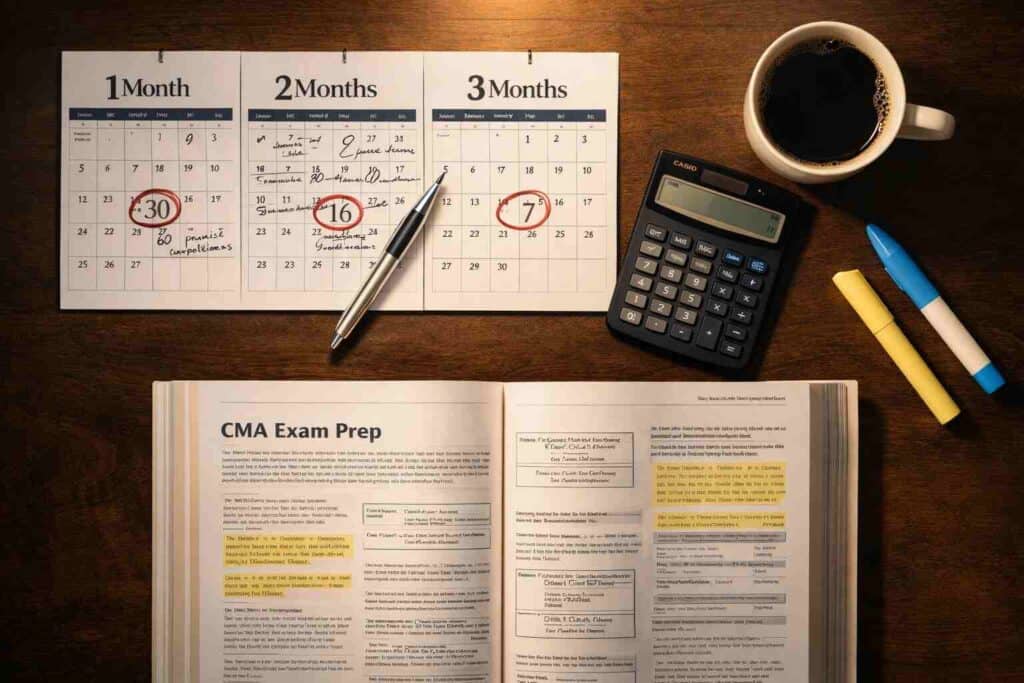
The great news is that it takes about 3 months to properly prepare for the CMA exam if you have a structured and focused study strategy in place.
This guide has been developed for working professionals and students living in the UAE who want a realistic, step-by-step game plan for studying for and passing the CMA exam. By the end of this guide, you will have a complete, month-to-month study schedule; proven tips to help you succeed; pointers on common mistakes; and an outline of a smart resource strategy to use in order to pass your CMA exam the first time you take it
What Is the CMA Exam? A Quick Overview
The Certified Management Accountant (CMA) exam consists of two sections; each section tests knowledge and skills that are important to being a successful management accountant.
- The first section, titled Financial Planning, Performance and Analytics, focuses on various topics including external financial reporting; planning and budgeting; performance management; cost management; internal control systems; and technology & analytics.
- The second section of the CMA exam, Strategic Financial Management, tests applicants’ knowledge of topics such as analysis of financial statements; corporate finance; decision analysis; risk management; investment decisions; and ethical conduct.
Every section includes two essay questions and 100 MCQs that will be covered over 4 hours. MCQs will take 3 hours, and your essays will take you 1 hour each.
In order to pass the exam, you’ll need to earn a completed score between 360-500. The MCQ section must be passed prior to starting the essay, making it important that you manage your time effectively from the very first day of studying.
There are 3 testing windows offered each year January/February, May/June, and September/October. Therefore, if you are taking the exam in 2026, make sure to register as early as possible for your target testing window.
CMA Exam Requirements: What You Need to Qualify
Prior to beginning preparation, ensure you meet the eligibility requirements:
Bachelor’s Degree: A completed bachelor’s degree from an accredited college/university will qualify. Some professional certifications may also qualify – see IMA’s site for more information.
Work Experience: To qualify for two consecutive years of professional experience (in either management accounting or financial management), this can be developed through two years of experience prior to passing the exam or within the 7 years.
You need to be an IMA member in order to take the exam. Different prices apply for the student or professional membership tier of IMA.
To register for the CMA exam:
- Join IMA as a member
- Submit the application for CMA candidacy
- Pay the entrance fee for the CMA exam
- Schedule your exam with Prometric
When registering for 2026 test windows, try to register at least 6 to 8 weeks in advance to get your preferred testing location and date.
Can You Really Prepare for the CMA Exam in 3 Months?
Yes, you can do it – but then again, doing it requires discipline!
According to the IMA, you will need a total of approximately 150-170 hours of study time for each part of the exam. This equates to 12-15 hours each week over a period of three months, or an average of two hours per day during the week and four to five hours on weekends.
By creating and using a structured plan that will allow you to study each week o(rather than randomly), you will achieve this goal. In addition, following these three key steps will also help:
- Focus on the most “weighted” (important) areas of the exam as early as possible.
- Utilize active recall methods rather than passive reading.
- Begin taking CMA practice questions no later than week three of your studying.
If you have either an accounting or finance background, three (3) months is usually the best timeframe for preparation. However, if you have no previous experience in these fields, an extended preparation timeframe of four (4) to five (5) months may be necessary for success; however, you’ll still need to have used the structured format outlined above.
3-Month CMA Exam Study Plan: Week-by-Week Breakdown
Month 1 – Build Your Foundation
Goal: Understand the syllabus deeply and master core concepts before touching practice questions.
Week 1–2:
- Study the IMA Learning Outcome Statements (LOS) for your chosen part
- Cover External Financial Reporting Decisions and Planning, Budgeting & Forecasting
- Read each topic once for understanding – don’t memorize yet
- Spend 30 minutes at the end of each session summarizing key points
Week 3–4:
- Move to Performance Management and Cost Management
- Begin attempting 20–30 MCQs per topic after completing each section
- Do NOT skip questions you get wrong – review every explanation
- Keep a “weak topics” list and revisit them every weekend
By the end of Month 1, you should have covered 50–60% of the syllabus and have a clear sense of where your gaps are.
Month 2 – Practice, Practice, Practice
Goal: Shift from learning to applying. This is where your CMA exam prep truly accelerates.
Week 5–6:
- Complete remaining topics: Internal Controls, Technology & Analytics (Part 1) or Corporate Finance, Risk Management (Part 2)
- Solve 50–75 CMA exam questions per day
- Begin timed MCQ sessions (simulate 1-hour blocks)
- Take one half-length mock test by the end of Week 6
Week 7–8:
- Focus on your weak topic list from Month 1
- Attempt essay questions for the first time – practice structuring answers clearly
- Join study forums or discussion groups to test your understanding
- Take a second full mock test and analyze your score, topic by topic
This month is critical. Many candidates skip straight to revision without enough practice – that’s a costly mistake. Consistent daily CMA practice exam work separates those who pass from those who don’t.
Month 3 – Revision, Mock Exams, and Exam-Day Readiness
Goal: Sharpen timing, build confidence, and eliminate remaining weak areas.
Week 9–10:
- Take one full-length mock exam every 4–5 days
- Review every wrong answer – understand why it was wrong, not just the correct option
- Create condensed revision notes (1 page per major topic)
- Focus extra time on high-weightage areas: for Part 1, that’s Planning/Budgeting and Cost Management; for Part 2, it’s Financial Statement Analysis and Decision Analysis
Week 11–12:
- Final full-length simulation under real exam conditions (4-hour timed attempt)
- Stop learning new material – only revise what you know
- Practice essay writing: aim for structured, concise answers within 25–30 minutes each
- Review your condensed notes daily
- Get your exam logistics sorted: ID, test center location, reporting time
By exam week, your job is to stay calm, sleep well, and trust the process you’ve followed.
Best Study Materials for CMA Exam Preparation
Choosing the right resources matters more than studying for long hours with the wrong ones.
Core Materials:
- IMA’s official CMA Learning System
- Wiley CMAexcel or Gleim CMA Review (both highly rated)
- Topic-specific video lectures for visual learners
For Practice:
- Gleim and Hock offer extensive CMA exam question banks with thousands of questions
- IMA’s official practice questions are excellent for understanding exam style
- Look for a free CMA exam practice test on platforms like IMA’s website or prep providers – these give you a realistic benchmark before committing to full preparation
For Essays:
- IMA releases sample essay questions – study these carefully
- Practice writing under time pressure, not just thinking through answers
Avoid using too many resources. One strong question bank and one solid review book per part is enough.
Common Mistakes to Avoid During CMA Exam Prep
- No study plan: Starting without a schedule leads to uneven preparation and panic in Month 3
- Skipping practice exams: Reading theory without solving questions won’t build exam skills
- Ignoring essays: Most candidates over-focus on MCQs and underperform in essays, which can cost them a passing score
- Using too many study materials: Switching between five different books creates confusion, not clarity
- Not tracking weak areas: If you don’t know where you’re losing marks, you can’t fix it
CMA Exam Cost Breakdown for 2026
| Fee Type | USD | AED (approx.) |
| IMA Annual Membership | $245 (professional) / $39 (student) | AED 900 / AED 143 |
| CMA Entrance Fee | $250 (professional) / $188 (student) | AED 918 / AED 690 |
| Exam Fee per Part | $415 (professional) / $311 (student) | AED 1,524 / AED 1,142 |
| Study Materials | $300–$700 (varies by provider) | AED 1,102 – AED 2,570 |
| Total Estimated Cost | $1,200–$1,600 | AED 4,408 – AED 5,878 |
Total estimated investment: $1,200–$1,600 for professionals, significantly less for students.
The CMA exam cost is a meaningful investment – which is exactly why a structured preparation strategy matters. Failing and retaking parts adds both time and expense.
How Acamind’s CMA Program Helps You Prepare Effectively
If you’re looking for structured guidance rather than self-study, Acamind Academy in Dubai offers a CMA preparation course that helps you in examinations.
What makes it practical for working professionals:
- Live instructor-led sessions with trainers who have real CMA experience – not just theoretical knowledge
- 10 full-length mock exams so you enter the real exam having already simulated the experience multiple times
- Flexible learning modes (online and offline) that fit around your work schedule
- Real exam-based CMA practice exam questions and case studies are built into the curriculum
- Personalized mentoring and doubt-solving so you’re never stuck on a concept for days
- KHDA-approved certification, adding credibility to your learning record in the UAE
If you’re serious about earning your CMA certification in 2026, Acamind’s program removes the guesswork and gives you a proven path forward.
FAQs Regarding CMA Examination Preparation
How many hours should one study for the CMA exam?
According to IMA, 150-170 hours of study are recommended for each section of the CMA Exam. To accomplish this in three months, this equates to approximately 12-15 hours per week or about two hours of study per day. This amount of preparation can be easily achieved if you commit to studying on a daily basis and set up a study routine and schedule.
Is the CMA Exam More Difficult than the CPA?
Both exams are challenging; however, they serve different functions. The CMA Exam is geared toward management-related subjects, including management accounting, strategic planning, and financial decision-making. Many CMA Exam candidates feel that the CMA Exam is more directly related to their work in corporate finance, so the CMA Exam seems to have more relevance.
Can I pass the CMA Exam in 3 months?
It is possible to complete the CMA Exam in 3 months; however, to do this, one should already have an accounting/finance background, follow a structured study program, and begin practicing exams earlier in the 3 months. Candidates who do not follow a structured plan to prepare for the exam will tend to take longer to prepare for and pass the exam.
What’s the best way to prepare for the CMA Exam?
During the first month of study, work on your exam prep with chapter-specific multiple-choice questions. In the second month of study, take timed exam simulations (4 hours each), and in the last month of study, take at least 3 to 5 full mock CMA Exams (which are at least 4 hours long). Look for a free CMA exam practice test to evaluate your level of preparation early in your CMA exam preparation.







 Call Us :
 Mail Us :
 Request a Call