
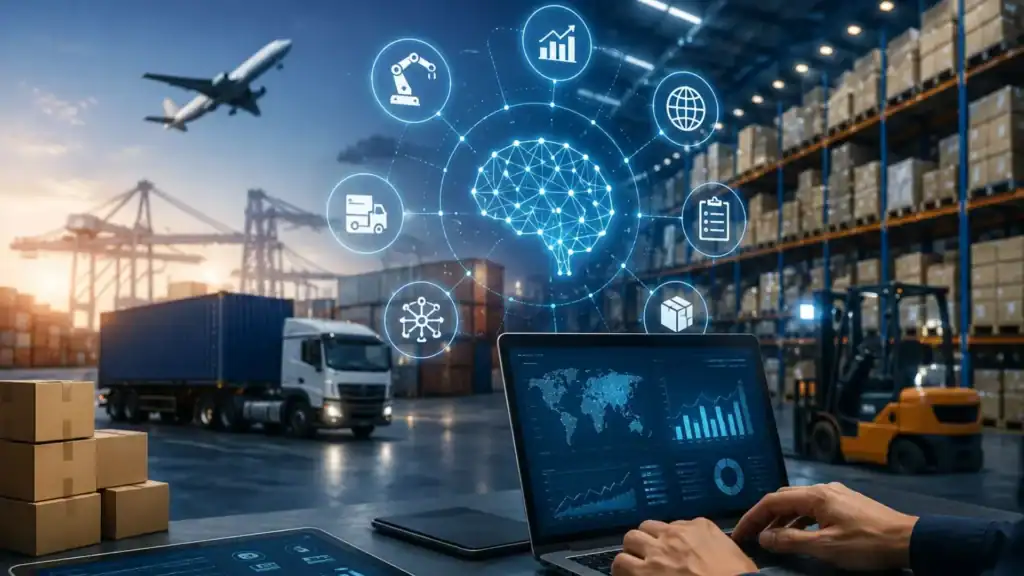
Key Takeaways
- AI in logistics is influencing forecasting, transportation, inventory, and operational planning.
- AI in supply chain can support faster analysis and better-informed decisions.
- Supply chain analytics helps professionals turn operational data into useful insights.
- Predictive analytics in supply chain can support demand, inventory, and risk planning.
- Transportation management is increasingly influenced by AI and automation.
- Strong logistics fundamentals remain essential alongside digital skills.
- Combining industry knowledge with AI capabilities can create stronger career opportunities.
The use of artificial intelligence in planning inventories, managing transport, demand forecasting, and handling disruptions has brought about many changes to how organizations operate. For logistic practitioners, this has meant that the knowledge to handle data and artificial intelligence has become as important as conventional operational expertise. There have been many instances in transportation where AI is used for various tasks.
However, this is not implying that people working in logistics have to become programmers, but they must learn about the importance of AI in logistics to help them make better daily decisions and where human knowledge is crucial. Having the appropriate skills will assist professionals in becoming more productive and knowledgeable about their operations.
1. Build AI Literacy for Logistics
The first is understanding the capabilities of AI in logistics. Experts need to be conversant with the processes of automation, machine learning, generative AI, and decision-making by AI.
AI can be used for the identification of trends in deliveries, organization of data, forecasting, and pointing out of operational problems. It is essential to know how to interpret the results rather than relying on AI suggestions.
Useful areas to learn:
- AI fundamentals
- Generative AI applications
- Workflow automation
- AI-assisted decision-making
- Data interpretation
- Responsible AI use
Many professionals with good industry understanding can benefit much from artificial intelligence even without good programming knowledge.
2. Develop Supply Chain Analytics Skills
The amount of information that is generated by today’s supply chain management processes, such as inventory control, warehousing, transport, purchasing, and customer orders, is immense.
Therefore, the knowledge of Supply chain analytics becomes extremely valuable for those specialists who wish to progress beyond the stage of ordinary operations management. Analytics allows teams to detect inefficiencies and evaluate performance.
Key capabilities include:
- Reading supply chain dashboards
- Tracking KPIs
- Analyzing inventory data
- Identifying operational trends
- Comparing supplier performance
- Turning data into business recommendations
The stronger your analytical foundation, the easier it becomes to understand where AI can actually improve a supply chain.
3. Learn Predictive Analytics
Classical supply chain planning usually makes good use of past data and manual predictions. With AI, however, the analysis of patterns can go even further and aid people in predicting future changes.
There is a whole range of possibilities related to predictive analytics in supply chains, which may be used for predicting demand, maintaining inventories, delivering goods, maintenance, and managing risks.
For instance, a company can make use of such data as historical demands, seasonal trends, and customer buying behavior to make better decisions about inventories.
Professionals should therefore learn how to:
- Interpret forecasts
- Identify relevant variables
- Compare predictions with actual outcomes
- Recognize forecasting limitations
- Use data to support planning decisions
4. Understand AI in Supply Chain Planning
Planning plays an integral role in supply chain management. Even a small error in the planning function could impact buying, production, storage, logistics, and customer services.
AI in supply chain management enables organizations to perform better when processing data and detecting links, which may not be evident otherwise. Nevertheless, technological advancement is not the sole solution for developing resilient operations. As pointed out recently by Reuters, even though AI allows companies to develop their forecasting capabilities, their vulnerabilities may persist if processes and decision-making frameworks are not adjusted.
This is why people require both technical and operational skills.
Focus on developing skills in:
- Demand planning
- Capacity planning
- Inventory optimization
- Supplier analysis
- Risk identification
- Scenario planning
5. Improve Transportation Management Skills
Technology is having an impact on logistics in the field of transportation as well. AI and automation could be used to help with route optimization, fleet management, scheduling deliveries, increasing fuel efficiency, and predictive maintenance.
According to Reuters, automation is becoming more widespread in all types of transportation, including road, rail, waterway, and air transportation, using AI for various uses such as navigation and equipment monitoring.
For professionals, understanding Transportation management means learning how technology can work alongside established logistics processes.
Important areas include:
- Route optimization
- Fleet performance
- Delivery scheduling
- Transportation costs
- Real-time monitoring
- Predictive maintenance
The objective isn’t simply faster delivery. Good transportation decisions also consider cost, reliability, safety, customer expectations, and operational constraints.
6. Learn Automation and Digital Supply Chain Tools
Automation can help decrease the volume of redundant activities in the process of logistics. These activities include inventory management, documentation, reporting, alerts, and regular data processing.
The staff should learn to collaborate with technology instead of perceiving it as a task for IT employees.
One helpful way to do this is to examine repetitive processes and see:
- Is this something that can be automated?
- What data does it require?
- How should the result be checked?
- What happens when the system makes an error?
- Where is human intervention still necessary?
These questions help professionals think about automation practically instead of chasing technology simply because it is new.
7. Strengthen End-to-End Logistics Knowledge
The ability to apply AI becomes significantly valuable only when people comprehend how the entire process works in a supply chain. A person operating with an inventory algorithm must understand how inventory impacts warehousing, procurement, transportation, cost, and delivery of goods to consumers.
That is why the study of Logistics and supply chain management becomes relevant despite the increasing usage of AI.
Professionals should understand areas such as:
- Inventory management
- Warehousing
- Procurement
- Capacity planning
- Supplier relationships
- Transportation
- Distribution
For professionals looking to strengthen this foundation, Acamind Academy’s Logistics and Supply Chain Management Course in Dubai is a practical option. This program spans 20 hours and touches upon inventory and warehousing, planning and capacity management, procurement and negotiations, and transportation and distribution. This program also includes training by industry experts, exercises, and a KHDA-certified certificate.
This program has been developed for the individuals who are professionals, students, those changing careers, and entrepreneurs, among other categories of people.
Why AI Skills Matter for Logistics Careers
The value of AI isn’t limited to one particular job title. Professionals across procurement, warehousing, transportation, inventory, planning, and supply chain management can benefit from better data and technology skills.
Someone who understands both logistics operations and AI-assisted analysis can contribute to decisions that involve:
- Reducing unnecessary inventory
- Improving delivery planning
- Identifying operational bottlenecks
- Monitoring supplier performance
- Improving demand forecasts
- Managing transportation costs
- Responding to disruptions
The combination of domain knowledge and digital skills is becoming increasingly relevant as supply chains become more connected.
A Practical Way to Build These Skills
Professionals don’t need to learn every AI application at once. A better approach is to build knowledge in stages.
Start with logistics fundamentals. Understand how inventory, procurement, warehousing, transportation, and distribution work together.
Build data skills next. Learn to read dashboards, analyze KPIs, and interpret operational information.
Then explore AI applications. Focus on forecasting, automation, route optimization, and decision support that relate directly to your role.
Finally, develop critical judgment. Understand how to question the output of AI, acknowledge the constraints, and integrate automated knowledge with practical experience.
The logistics and supply chain program by Acamind Academy adopts a structured approach, including logistics operations, inventory, warehousing, purchasing, planning, and transportation. Its course page also highlights real-world case studies and hands-on exercises designed around practical job skills.
For additional reading, Acamind’s guide on the importance of logistics and supply chain management can also help professionals understand why strong supply chain capabilities remain important as technology changes the industry.
Conclusion
AI is becoming part of everyday logistics, from forecasting and inventory planning to transportation and operational monitoring. But technology doesn’t eliminate the need for logistics expertise. This makes such skills even more valuable for the professionals who understand how to use them in conjunction with the data and AI.
Gaining skills in AI in logistics, analytics, predictive forecasting, automation, transportation, and the basics of the supply chain will allow professionals to adjust to evolving jobs and make better operational decisions. The best career path is not learning AI itself but applying AI to practical cases in supply chains.
FAQs
What makes AI essential for logistics?
There are many different aspects in which AI can assist the logistic manager in data analysis, forecast making, transportation optimization, automation of the process, etc.
Do logistics professionals need to know how to code to study AI?
It might not be necessary, as many practical AI implementations would require knowledge of data, processes, and AI techniques rather than complicated programming skills.
How will AI be integrated in supply chain management?
AI can be incorporated through several different ways, like demand planning, stock management, vendors, routing, warehousing, and decision-making, among others.
What are the required skills for logistics specialists in 2026?
They must acquire knowledge of AI technology, analytics, predictive forecasting, automation, transportation, inventory management, and the whole process of supply chain.
Is logistics knowledge still important while using AI?
Absolutely. Any AI tool needs to be understood in its operational context. Knowledge of procurement, inventory, warehousing, transportation, and distribution is always relevant.








 Call Us :
 Mail Us :
 Request a Call