Key Takeaways
- Recruitment processes will be sped up and made more efficient by AI.
- AI aids HR departments in finding skill deficiencies and future talent requirements.
- Skill-based recruitment can help find more suitable candidates.
- Human judgment cannot be overlooked in HR decisions assisted by AI technology.
- AI skills have become increasingly valuable for contemporary HR practitioners.
Hiring is not simply about filling vacant posts anymore. HR departments need to be aware of the skills that the company requires, areas where there could be a shortage of talent, and how the changing technology would affect future workforce demands.
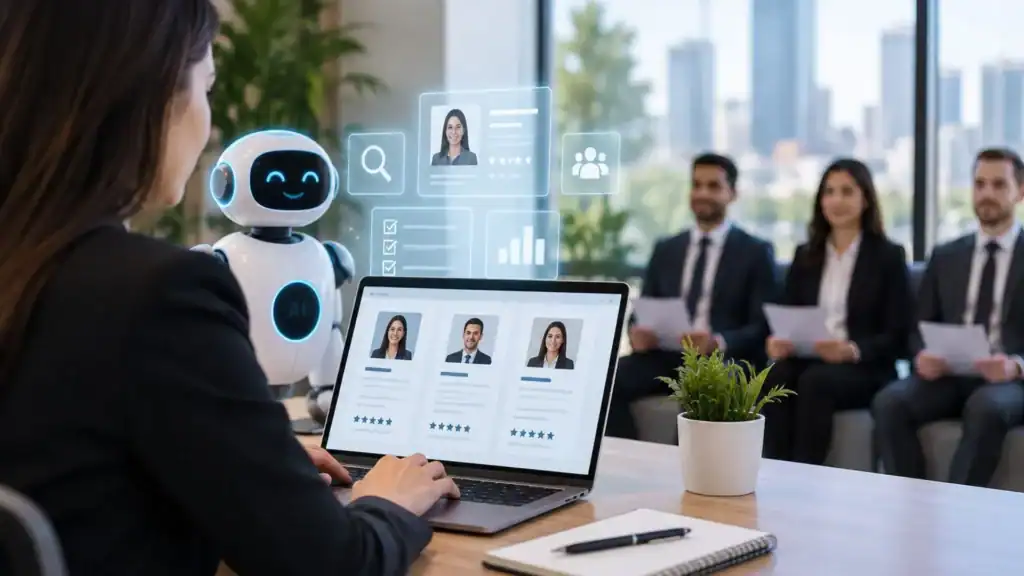
Here comes the use of AI in recruitment. It will aid HR experts in managing data about the candidates, recognizing patterns within the workforce, skills-based hiring, and automating repetitive processes.
As per SHRM’s study for 2026, recruiting is the most popular domain of AI use in HR today, including resume screening, scheduling interviews, job advertising, and job candidate matching.
What Does AI Bring to Recruitment?
AI isn’t necessarily about replacing recruiters. Its practical value lies in handling information-heavy tasks that can take hours when completed manually.
HR teams can use AI to:
- Organize candidate applications
- Compare skills against job requirements
- Draft and improve job descriptions
- Schedule interviews
- Analyze recruitment data
- Identify potential candidate matches
- Support routine candidate communication
This gives recruiters more time for interviews, relationship-building, and decisions that require human judgment.
1. Create More Targeted Job Descriptions
An efficient job description will draw suitable candidates for the job.
AI can help HR personnel in creating a draft version using the duties, skills, and experience required for the job. The recruiters then need to revise the description so that it correctly matches the job position.
Human intervention is necessary in reviewing the final draft.
2. Speed Up Candidate Screening
An applicant could send hundreds of resumes for one job. The manual review of all resumes will only take time.
The use of AI for screening resumes can be helpful in organizing resumes based on requirements, including qualifications, experience, and relevant skills.
However, one must consider it as just a preliminary stage because there could be people with experience and skills that an automated system cannot detect.
3. Support Skills-Based Hiring
The most practical way that the AI for HR can be used in recruitment is to aid them in recruiting people who fit the required qualifications outside of the job description.
An individual might not be in the required job title but still be qualified enough in that field of expertise.
For instance, an individual with past experience in managing various aspects of projects can be considered a project manager despite having never been one officially.
4. Turn Recruitment Data Into Insights
Recruitment teams generate considerable amounts of data, but simply collecting it isn’t enough.
AI can help HR professionals examine information such as:
- Time-to-hire
- Candidate sources
- Offer acceptance rates
- Hiring costs
- Interview conversion rates
- Employee turnover
- Recruitment funnel performance
They will point out areas in which the recruiting efforts are successful and others in which the recruiting strategies have to be changed.
For example, HR may find out that one of the recruitment channels attracts a large number of applicants but a small number of hires.
5. Connect Hiring With Workforce Planning
Recruitment and workforce planning should work together.
If a business plans to expand a department, HR needs to consider more than the number of employees required. It also needs to understand which capabilities those employees should bring.
This is where AI workforce planning can help.
AI-supported analysis can help organizations examine:
- Current workforce skills
- Employee turnover
- Staffing patterns
- Future role requirements
- Potential skills shortages
- Workforce growth
- Internal mobility opportunities
6. Identify Future Skills Gaps
The staff the organization will need tomorrow may be quite different from the staff that it is currently using.
AI can assist HR departments to examine the skills possessed by their employees in comparison with future needs. This would show where the organization should recruit, reskill, or upskill.
This change is important since workforce planning is shifting focus towards capability planning and not just staffing anymore.
For instance, if an organization adopts more automation processes, it could require its employees to have better skills in data analysis, digital, or AI.
7. Find Internal Talent
Workforce planning is not always about making external hires.
There might be times when the right person for the job is already in the organization.
AI can be used to determine which employees within the organization have the required set of skills that can be transferred to different jobs or new jobs created.
8. Improve the Candidate Experience
AI can also handle straightforward candidate interactions.
For example, the system can assist in answering basic queries, providing information about applications, and scheduling.
Such a system would ideally serve to make things easier and more time-saving for the recruiter.
However, human intervention is still very necessary. The candidate might want to discuss complicated matters that the machine will be unable to deal with.
The goal here is making the recruiting process better, not automating everything.
9. HR Professionals Need AI Skills
Introducing AI into an HR department requires more than purchasing software.
HR professionals need to understand how AI works, how to evaluate its recommendations, and where its limitations lie.
Useful skills include:
- AI fundamentals
- Data interpretation
- AI-assisted HR workflows
- Responsible AI
- Data privacy
- Critical thinking
- AI tool evaluation
If organizations wish to enhance HR competencies in addition to technology within the workplace, Corporate Training in HR from Acamind Academy would be an option that could form part of their overall employee development program.
This would ensure that HR practitioners operate with technology but remain focused on people within HR decision-making.
10. Responsible AI Matters in Hiring
The issue of recruitment demands extra caution, as the impact of AI will be felt by people’s career advancement.
The AI could perpetuate biases that exist in the historical recruitment data or miss out on applicants who don’t fit in the system.
HR teams should therefore monitor:
- Bias and fairness
- Data privacy
- Accuracy
- Transparency
- Human oversight
- Appropriate use of candidate information
AI Should Assist HR, Not Replace It
The strongest use of AI in human resources is collaborative.
AI in HR course is efficient and recognizes patterns. HR experts know the culture of the organization, the expectations of the employee from the employer, the needs of the organization, and the human factor of hiring.
Thus, for instance, AI can choose ten candidates that seem to fit the job. But the recruiter still needs to see which of them is a good communicator, knows the position, has potential, and will be successful within the organization.
That distinction matters.
How HR Teams Can Start Using AI
Companies don’t need to introduce AI into every HR activity immediately.
A practical approach is
Problem: Determine which repetitive activities take up the actual time of HR professionals.
Select the right use case: Start from small applications like scheduling, writing job descriptions, or recruiting analysis.
Train the team: Ensure that HR personnel are familiar with the potential and limitations of artificial intelligence.
Incorporate human review: Determine what kinds of decision-making require human input.
Evaluate outcomes: Monitor effectiveness, precision, experience of candidates, and ethics.
Scale gradually: Expand to other use cases rather than using the technology just because it is available.
For employees who want to develop practical AI capabilities for everyday professional tasks, Acamind Academy’s AI for Workplace Productivity is another relevant option.
What Is the Future of AI in HR?
The future of AI in HR might entail both automation and human know-how.
In this regard, for HR departments, this would mean that their job would be transformed into interpreting information about the workforce, redesigning jobs, creating new skills, and helping workers adjust to technological advances.
Recruiting could become a strategic affair as well. Rather than filling vacancies as they appear, HR people could use information about the workforce to predict when recruiting would be necessary and provide advice to company management before that.
Conclusion
The use of AI in recruitment can assist HR departments in managing applications, identifying skills, analyzing data about hiring, improving workforce planning, and making recruitment processes more efficient.
However, AI technology is supposed to assist HR professionals in making decisions instead of making decisions by itself.
The best strategy would be to combine capabilities of AI technologies in terms of information processing with those human qualities that HR professionals have, such as judgment, communication, empathy, context awareness, and responsibility.
In the future, with the development of skills-based workforce planning, HR professionals with expertise in people and AI will have great opportunities to influence business hiring and the development of talent.
FAQs
What is the use of AI in recruiting?
Applications of AI include resume filtering, writing job descriptions, matching candidates, interviewing, recruitment metrics, and communication with candidates.
Is AI capable of replacing HR recruiters?
AI can take care of some things, but the recruiters are required for interviews, building relations, and evaluating the candidates.
How does AI support workforce planning?
It will help companies to analyze their workforce, find skill gaps, notice patterns in staffing, and predict future talent needs.
What is AI in HR?
AI in Human Resource Management means that artificial intelligence is used in the field of HR management, which includes recruitment, staffing, learning, analysis, and talent management.
Why is it important for HR managers to know about AI?
AI knowledge can enable HR managers to assess technologies, find potential use cases, mitigate risks, and make decisions based on technology.






 Call Us :
 Mail Us :
 Request a Call