Key Takeaways
- AI can personalize workplace learning and identify skills gaps.
- AI skills for employees must cover both technical knowledge and human reasoning.
- Simulations will help to make training interesting and relevant.
- The use of AI knowledge is becoming relevant to other departments besides technical.
- The training in terms of the responsible use of AI, privacy, and verification is also to be taken into account.
- Continuous learning will be even more essential in connection with the evolving workplace skills.
- The human coach will still be highly significant in the process of learning.
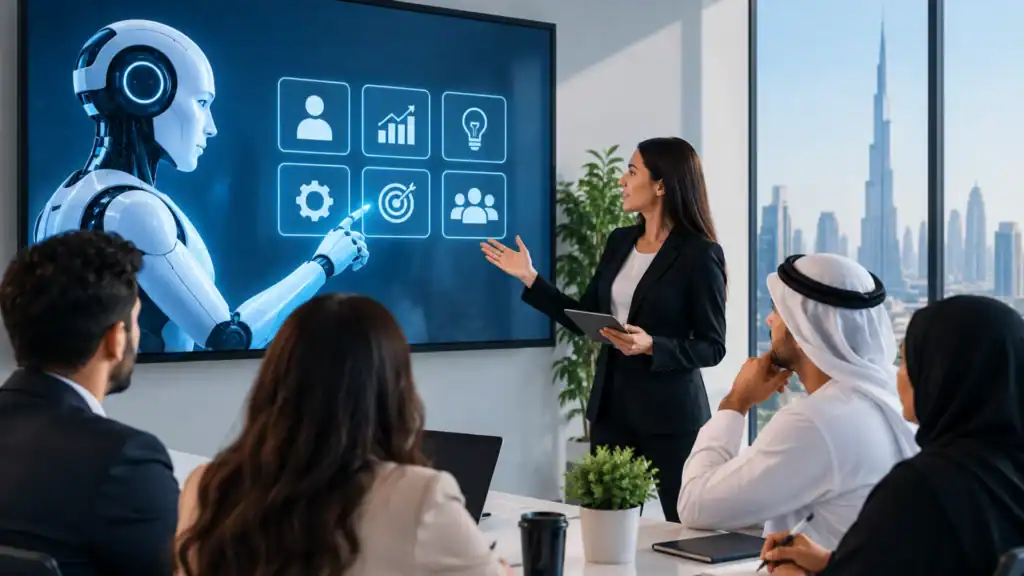
Employee training is evolving. Employee training was previously conducted during seminars or annual development sessions. However, since AI is now being implemented in routine work practices, organizations are reconsidering the ways in which people learn and develop their competencies.
The implementation of AI in employee training has become increasingly necessary at this point. AI provides opportunities for personalized learning, instant feedback, creation of realistic training situations, and assessment of skills gaps within organizations. However, besides accessing AI tools, employees should be taught how to use them.
Why AI Is Changing Employee Training
In traditional training, the same material is delivered to all workers irrespective of their prior knowledge levels. AI enables personalization of training for workers.
This is because one worker who is conversant with AI principles can proceed with applying his skills, while a novice can receive extra training.
AI can support:
- Personalized learning paths
- Skills-gap assessments
- Automated feedback
- Practice exercises
- Simulations
- Progress tracking
- On-demand learning support
1. AI Literacy Is Becoming a Workplace Essential
It is not necessary that employees become experts on AI, but they will definitely have to know the basics of how the technology works and where it applies to their job roles.
For instance, HR professionals can use it to support recruitment, marketers can use it to conduct research, and the finance department can employ it to analyze data.
AI workplace skills become relevant for various departments in this way.
AI competency does not just stop with the tools; employees need to understand its limitations, verify the results, handle confidential information, and even know when human judgment is preferable over AI solutions.
2. AI Can Personalize Learning
Not all employees require the same kind of learning.
An intelligent system will be able to see where an individual struggles and customize learning in a manner that suits the employee. An employee who excels at something gets to progress, while the other individual gets to learn more about it.
This can make AI training for employees more effective.
Rather than go through a training program just for the sake of it, the employees can focus on acquiring skills that are important.
3. Training Can Become More Practical
AI can create realistic workplace situations for employees to practice.
A manager could rehearse a difficult conversation. A salesperson could practice handling objections. An HR professional could work through a recruitment scenario. An employee could practise writing or presenting information.
This type of simulation allows people to make mistakes in a low-pressure environment before applying the skill at work.
AI can also provide immediate feedback, although human trainers remain important for context, coaching, and professional judgment.
4. AI Skills Go Beyond Technical Knowledge
An effective AI workforce requires not only workers that have expertise in using AI technologies.
People also need:
- Critical thinking
- Communication
- Problem-solving
- Creativity
- Data awareness
- Adaptability
- Ethical judgment
So AI skills for employees should combine technology awareness with the ability to make thoughtful decisions.
5. AI Supports Continuous Learning
Just because training concludes does not mean that an employee has completed his or her training program.
The AI is able to help continuously through explanations, creating examples, practicing skills, and self-learning.
This is important as future workplace skills will be changing very rapidly. Organizations increasingly need learning systems that can keep pace rather than relying only on occasional training sessions.
6. AI Can Help Identify Skills Gaps
Before designing a training program, an organization has to figure out what needs to be taught to its employees.
With the help of AI, an organization will be able to analyze its evaluations, job demands, learning outcomes, and any other information about the workforce in order to find possible gaps.
For instance, if an organization uses AI customer service software, training will be provided to employees who need help with mastering the new technology, not everyone else.
In such a way, AI workforce development becomes more relevant to business needs.
7. Digital Skills Training Will Become More Role-Specific
A finance employee and an HR professional may both need AI knowledge, but they won’t necessarily use it in the same way.
Finance teams may need AI for analysis and reporting. HR teams may focus on recruitment and employee data. Marketing teams may use AI for research and content development.
This means digital skills training is likely to become more closely connected to individual job functions.
A practical structure could include:
For everyone: AI fundamentals, responsible use, privacy, and basic prompting.
For managers: AI-assisted decision-making, team adoption, and workflow improvement.
For specialists: Advanced AI applications relevant to their specific function.
8. Responsible AI Should Be Part of Training
Employees need to understand that AI-generated information isn’t automatically accurate or appropriate.
Training should address:
- Data privacy
- Bias and fairness
- AI limitations
- Human oversight
- Responsible tool selection
- Verification of AI outputs
This is particularly important when employees work with confidential customer, employee, or business information.
9. AI Can Support Trainers Rather Than Replace Them
AI can help trainers create quizzes, learning materials, practice exercises, simulations, and basic feedback.
That doesn’t remove the need for human trainers. Instead, it can give them more time to focus on coaching, discussion, practical guidance, and complex situations.
The strongest approach is therefore not necessarily AI replacing instructors. It is AI supporting instructors while keeping people involved in important learning decisions.
10. Businesses Need an AI-Ready Workforce
It is already true that organizations are making efforts in boosting the artificial intelligence competencies of employees. In September 2026, Wipro announced that it has been training more than 100,000 employees in advanced AI skills as a part of its AI strategy.
Organizations that are at the starting stages of their AI journey can find that the Corporate Training in AI Dubai offered by Acamind Academy can be integrated as a part of an organized strategy for workforce development.
The objective is not to train the employees on every new AI technology but to make them understand the potential of AI.
Conclusion
AI in employee training is changing both what employees learn and how organizations deliver learning.
The objective is not to transform all employees into highly technical individuals. The objective is to ensure that people have the ability and knowledge to function well alongside AI.
The future of AI in the workplace development will likely combine AI capabilities with human strengths such as creativity, communication, critical thinking, leadership, and adaptability.
Acamind Academy makes learning practical and role-specific skills that prepare their workforce for changing responsibilities without losing sight of the human skills that remain essential.
FAQs
Why is AI important in employee training?
AI can offer personalized training, feedback, and simulations and help organizations determine skill gaps.
Which AI skills should be included in employee training?
The skills to be covered during the training include fundamentals of AI, practical applications in the workplace, prompting, proper use of AI, data privacy, and evaluation of the output from AI.
Will AI take over workplace trainers?
This may not always be the case since AI can take care of routine tasks while human trainers can offer coaching and judgment, among other things.
Is AI training necessary for non-technical workers?
It is because many applications of AI at work do not necessarily need programming.
How can businesses kick off AI training?
An organization may start by assessing existing skills, role-based skills, providing fundamentals of AI, and practicing AI in a real-world situation.






 Call Us :
 Mail Us :
 Request a Call