Key Takeaways
- Upskilling strengthens skills within an existing career path.
- Reskilling prepares employees for different roles.
- The right approach depends on the organization’s future needs.
- AI literacy is becoming relevant across many non-technical jobs.
- Practical training is more effective when employees can apply it directly.
- Continuous employee skill development can benefit both businesses and employees.
Technology is changing the workplace environment, but not all changes will lead to the extinction of that specific job. Instead, people need to be educated in how to cope with the new environment at work.
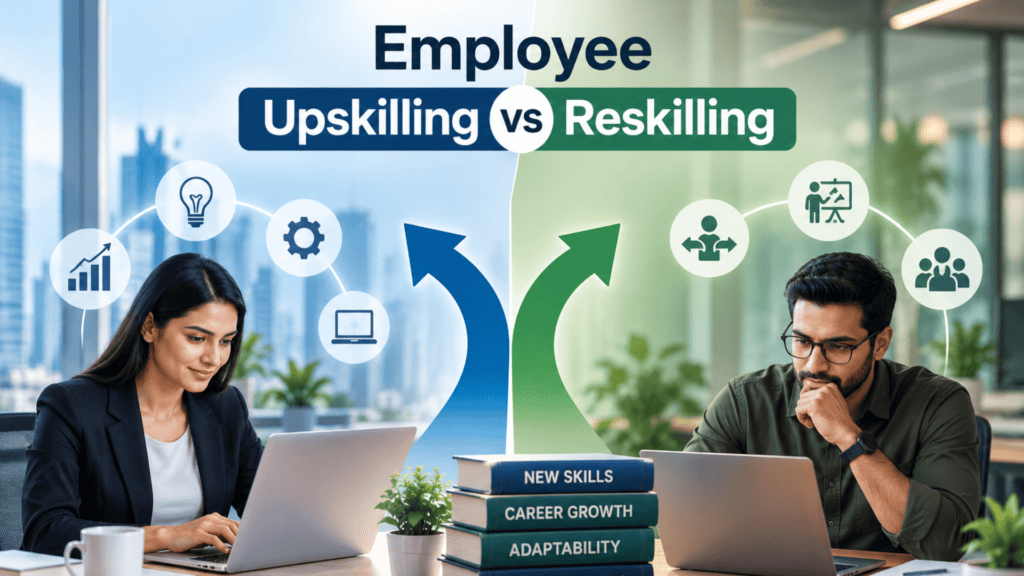
This is why the discussion about upskilling vs reskilling has become significant among organizations. Even if the two terminologies are usually discussed in tandem, they answer to different challenges. Upskilling assists the workers to become more competent in their respective occupations, while reskilling equips them to handle another occupation altogether.
The clarification that Acamind Academy gives is relevant since companies need to be aware of what they have to improve on their end.
What Is Employee Upskilling?
Employee upskilling means additional or advanced employee skill development that supports their existing role.
For example, a marketing executive might learn data analytics, an HR professional could learn AI tools, or an accountant might develop stronger financial modelling skills.
The employee’s career direction remains broadly the same, but their capabilities expand.
Common examples include:
- A salesperson learning CRM analytics
- An HR professional learning people analytics
- A finance employee learning advanced Excel
- A marketer learning AI-powered tools
- A manager improving coaching skills
- An administrator learning workplace automation
Upskilling is particularly useful when a role remains relevant but its requirements are evolving.
What Is Employee Reskilling?
Employee reskilling refers to acquiring a new skill set for an employee to occupy another role.
Imagine a company that automates several administrative processes. Some employees may have transferable knowledge and could move into areas such as customer operations, data analysis, or digital support after receiving appropriate training.
That is reskilling.
According to the OECD, reskilling is the process of equipping individuals with skills required for them to move from one occupation to another due to changes that have occurred in the former.
Upskilling vs Reskilling: The Main Difference
The simplest way to remember it is:
Upskilling improves your current career path. Reskilling prepares you for a new one.
| Factor | Upskilling | Reskilling |
| Main goal | Improve current capabilities. | Prepare for a different role. |
| Career direction | Usually stays similar | Often changes |
| Skills | Advanced or complementary | New skill set |
| Example | Accountant learning financial analytics | Accountant moving into data analysis |
| Common trigger | New technology or responsibilities | Automation, restructuring, or new business needs |
There is no inherently superior method for both. The appropriate path to take is dependent upon the qualifications of the employee and the future needs of the company.
Why Employee Upskilling Matters
There is no requirement that companies have to look outside for filling the skill gaps.
The existing staff members know all about the organization’s customers, its systems, its processes, and its culture. Combining this knowledge with the newly acquired skills can further increase their value.
Thus, workforce upskilling becomes an efficient way to train workers for the upcoming challenges.
An HR specialist who knows how to use artificial intelligence would be able to automate some routine tasks and concentrate on people.
Why Employee Reskilling Matters
Reskilling becomes even more important if the position of the employee changes significantly.
It is technology that may make some job responsibilities obsolete but at the same time create a necessity to develop completely new competencies. This issue should not be considered only from the recruitment perspective; instead, organizations should try to utilize the skills of their employees.
This approach can support workforce reskilling while allowing organizations to retain valuable experience.
It can also give employees a realistic alternative when their original responsibilities are changing.
How AI Is Changing Skills Development
AI has increased the significance of continuous learning.
This does not imply that all employees have to learn programming.
For many workers, the urgent requirement is that of knowing about the functioning of AI, the areas where it can be deployed, prompt writing, and assessing information generated through AI.
This relevance of AI skills for employees becomes applicable to various departments like HR, finance, marketing, administration, and operations.
AI Upskilling Doesn’t Have to Be Technical
AI training is sometimes associated with coding and complex technology. For most employees, that isn’t necessarily the starting point.
Professionals may use AI to:
- Summarize information
- Draft and edit documents
- Support research
- Create presentations
- Organize ideas
- Analyze information
- Automate repetitive tasks
- Improve everyday productivity
For businesses that want to introduce AI knowledge across non-technical teams, Acamind Academy’s AI Literacy Program in Dubai provides training around AI fundamentals, generative AI, prompting, workplace applications, and responsible AI use.
This is a good example of upskilling rather than reskilling because employees can add AI capabilities without necessarily changing their existing career path.
When Should a Company Upskill Employees?
Upskilling is generally appropriate when:
- The current role is still relevant.
- Technology is changing how the job is performed.
- Employees already have a strong foundation.
- The business needs deeper expertise in an existing function.
- Employees are preparing for greater responsibility.
- New tools require additional capabilities.
For instance, where a firm is seeking to introduce new software, it may be sensible to train the existing accountants rather than replace them. Their knowledge in accounting is still relevant; they only have to acquire one more skill.
When Should a Company Reskill Employees?
Reskilling may be a better option when:
- A role is changing substantially.
- Automation reduces the need for existing tasks.
- The business is entering a new area.
- New roles are becoming more important.
- Employees have transferable skills but need a different technical foundation.
- The organization wants to redeploy existing talent.
Here, the goal is not to make someone better at their current job. It is to prepare them for a different opportunity.
How Can Businesses Choose Between the Two?
Companies can begin with three practical questions.
1. Is the current role still relevant?
In that case, upskilling could suffice. In case the position is evolving significantly, then reskilling would be a better choice.
2. What skills are missing?
A small gap could require a short course or workshop. A larger gap may require a structured learning pathway.
3. Where can the employee contribute most?
Take into consideration not only the present strengths of the individual but also the future requirements of the organization.
Make Employee Training Practical
The usefulness of training increases significantly once employees can utilize the knowledge gained.
For example:
- A marketer can use analytics skills on a real campaign.
- An HR professional can test AI for routine tasks.
- A manager can practice delegation with their team.
- A finance employee can create a new reporting model.
- An operations employee can identify a process suitable for automation.
This turns employee training and development into something connected to everyday business rather than a box that simply needs to be checked.
Both Approaches Support Career Growth
Upskilling and reskilling aren’t only valuable to employers. They can also give employees greater confidence about their future.
That makes continuous learning increasingly relevant for people at different stages of their careers.
A Simple Skills Development Approach
Businesses can keep the process straightforward:
Assess: Assess current skills and future requirements.
Identify: Focus on those skills that need to be addressed.
Evaluate: Consider whether it is time to upskill or reskill your employees.
Train: Provide the proper training or workshop.
Apply: Give employees the chance to utilize their new skills.
Evaluate: See if the training has had an effect on their performance or created new chances for them.
Thus, there will be a continuous process of development rather than sporadic training.
Conclusion
The main distinction between upskilling vs reskilling depends on the path an employee wants to take in his/her career.
Upskilling allows individuals to develop new skills that will enable them to become more efficient in their current jobs. Through reskilling, they will be well-prepared for a totally new assignment.
Both techniques have value in today’s employment world.
With the increasing presence of artificial intelligence, automation, and other digital instruments in the working environment, companies don’t always have to hire another person to fill the gap in skills. Instead, they may ask themselves another question: how much can be done by a current employee with proper training?
FAQs
What is the distinction between upskilling and reskilling?
Upskilling is about gaining new skills for the present job, while reskilling involves gaining new skill sets in order to take up a new job.
Is AI training upskilling?
Most often, yes. Training of employees in using AI tools to do their job better is considered upskilling.
When should companies reskill employees?
The need for reskilling will arise if there is a drastic change in jobs, if the impact of automation affects the present jobs performed by employees, or when employees have to perform a new task.
Why is upskilling employees important?
It enables individuals to survive in this ever-evolving environment and enables the organization to build a stronger team.
What are the prerequisites for the learning of AI by employees?
There are none. Many of the AI literacy courses do not require any technical background.







 Call Us :
 Mail Us :
 Request a Call